Lafiya Nigeria
Lafiya Nigeria focuses on expanding access to family planning products in underserved communities in Nigeria.
SAYANA PRESS CHALLENGE; NIGERIA

PROVEN INTERVENTION TO BE DISTRIBUTED
Sayana Press injectable contraceptive.
Learn more about the Sayana® Press Challenge and why training health providers to administer Sayana® Press can be particularly valuable for women who prefer injectable contraceptives but don’t have regular access.
DISTRIBUTION MODEL INNOVATION
Lafiya Nigeria trains midwives, nurses, and community health workers to become “Lafiya Sisters,” specialists in family planning. Their team ensures that new mothers in hard-to-reach communities receive family planning counselling and access to contraceptives—like injectables—right after childbirth, empowering women to take control of their reproductive health.
Their mission is to empower women to have control over their reproductive autonomy. Lafiya Nigeria was started in 2021 by Yifei Jefferson Chen and Klau Chmielowska.
PILOT RESULTS AND SCALING GOALS
Distributed 800 doses of Sayana Press to women in three months
Reached 2,700 women by the end of Year 1
Reached 10,700 women by the end of Year 2
Reach 50,000 women by the end of Year 3
FOUNDING TEAM
Klaudia Chmielowska - Co-Founder and Executive Director
Yifei Jefferson Chen - Co-Founder and Director of Partnerships
HealthPort
HealthPort improves access to medical oxygen in Nigeria through digitized clinician support and oxygen equipment asset management.
OXYGEN CHALLENGE; NIGERIA

PROVEN INTERVENTION TO BE DISTRIBUTED
Service and repair of oxygen concentrators.
Learn more about the Oxygen Challenge and why repairing and maintaining oxygen concentrators in low-resource hospitals expands access to medical oxygen - a key treatment for pneumonia, malaria, sepsis, meningitis, and Covid-19.
DISTRIBUTION MODEL INNOVATION
HealthPort improves access to medical oxygen through digitized clinician support and oxygen equipment asset management.
HealthPort is a health tech venture improving access to quality medical care by using digitized solutions to efficiently manage care delivery and resource availability in low-resource settings. Using low-cost solutions, we intend to improve oxygen access and hypoxemia outcomes by strengthening capacity among local biomedical technicians, improving clinician ability to assess oxygen needs using simple quality improvement interventions, and medical asset management for rural healthcare facilities in Nigeria.
The HealthPort solution focuses on improving care delivery skill sets and establishes a foundation for digital medical device assets management. Maintaining oxygen concentrators under our distribution model will improve access to medical oxygen and increase prioritization of low flow oxygen needs.
PILOT AND SCALING GOALS
Train 10 biomedical technicians to service 50 Oxygen concentrators, reaching 1,000 patients during the pilot phase.
Improve clinician ability to assess oxygen need by 80% and decrease hypoxemia related mortality in regions where we work by 20-40%.
Raise an additional $20,000 within 3 Months
FOUNDING TEAM
Aishat Adeniji - Co-Founder/Clinical Operations Lead
Oladeji Sofoluke - Co-Founder/ Health Center Relations
James Adebayo - Biotechnician
Family Empowerment Media
Family Empowerment Media is an evidence-based non-profit that enables informed family planning decisions through clear, compelling, and accurate radio-based communication.
CUSTOM CHALLENGE; NIGERIA

PROVEN INTERVENTION TO BE DISTRIBUTED
Family planning information through radio-based communication
Learn more about the Custom Challenge and why we only fund ideas that focus on distributing proven poverty interventions.
DISTRIBUTION MODEL INNOVATION
Family Empowerment Media (FEM) is an evidence-based non-profit that enables informed family planning decisions through clear, compelling, and accurate radio-based communication.
The FEM model is simple and transferable to many regions in Nigeria and, eventually, other countries. FEM works with local partners to produce and broadcast radio programming that shifts knowledge, attitudes, and behavior around family planning in Nigeria. The FEM solution is cost-effective because (1) radio programming is cheap in West Africa, and (2) the full-time team is lean - but complemented by part-time surge support when needed.
Accomplishments
Reached ~35 million listeners through short and long campaigns in first three years
Externally evaluated to be as much as 20-60x as cost effective as cash transfers
An external evaluator found FEM’s pilot correlated with a 75% increase in contraceptive uptake in the region.
SCALING GOALS
Reach 50 million listeners in Nigeria by 2030
Conduct one pilot in a new country and one pilot on a new health topic
Conduct a randomized controlled trial of their evaluation in 8 states in Nigeria
FOUNDING TEAM
Anna Christina Thorsheim - Director
Kenneth Scheffler - Director
Suvita
Suvita increases uptake of immunization services to combat vaccine-preventable diseases.
IMMUNIZATION CHALLENGE; INDIA

PROVEN INTERVENTION TO BE DISTRIBUTED
Routine childhood immunizations.
Learn more about the Immunization Challenge and how increasing routine childhood immunization rates in low-coverage areas could prevent millions of childhood deaths.
DISTRIBUTION MODEL INNOVATION
Suvita increases uptake of immunization services to combat vaccine-preventable diseases.
Suvita identifies natural community influencers through peer nominations, and invites them to become immunization ambassadors who motivate and remind others in the community to bring their children for routine immunisations. The model complements this with customized SMS reminders direct to new parents, which follow their child's immunization schedule. These two evidence-based programmes have been shown to boost uptake of immunization in a randomised controlled trial in Haryana, India, by Nobel Laureates Abhijit Banerjee, Esther Duflo and colleagues - and the Suvita team is taking them to scale.
PILOT AND SCALING GOALS
Establish embassadors in 50 villages, covering 5,000 eligible children during the pilot
Raise $50,000 during the pilot
Reach 50,000 beneficiaries by the end of year 1
FOUNDING TEAM
Varsha Venugopal - Co-founder
Fiona Conlon - Co-founder
ElleSolaire
ElleSolaire is the first women-led, pay-as-you-go clean energy distribution network in West Africa.
SOLAR LAMP CHALLENGE; SENEGAL

PROVEN INTERVENTION TO BE DISTRIBUTED
Solar Lamps.
Learn more about the Solar Lamp Challenge and how these lamps create enormous benefits for developing world families.
DISTRIBUTION MODEL INNOVATION
ElleSolarie is the first women-led, pay-as-you-go clean energy distribution network in West Africa.
In Senegal, six million people live without electricity. 58% of the population is rural and the women in these communities suffer the most from energy poverty and the implicit time poverty. They rise with the sun, often completing up to 17 hours of domestic tasks each day, leaving very little opportunity for endeavors that could improve lives, including their own. What’s more, their sources of energy are often pollutant, dangerous, and costly.
Women entrepreneurs from rural communities in Senegal are being recruited and trained by ElleSolarie. They become business women in their own right, distributing much needed, cutting-edge clean energy solutions on affordable pricing plans to remote last mile communities.
ElleSolaire is about women helping women to help themselves with economic opportunity, while growing in confidence, dignity, and choice. It is also about helping their families and communities to tap into a life-changing energy source that is safe, clean, and plentiful: sunlight. Customers get to reduce costs, health risks, environmental damage, and time given to domestic tasks. Solar energy is a key source of poverty alleviation that also increases opportunity through communication, business and studies.
IMPACT TO-DATE:
55 women and youths trained
545 women benefiting economically
2,005 households connected to clean energy source
35,000 people benefiting from clean, safe light in their home and Health Clinic
18 off-grid Health Clinics electrified
2021-2025 SCALE-UP PLANS
350 women trained as clean energy managers
8,250 women benefiting economically
40,000+ households connected to clean energy source
335,000 people benefiting from clean, safe energy source in their home and/or Health Clinic
FOUNDING TEAM
Kelly Nwachuku Lavelle - Founder, Executive Director
Mukuru Clean Stoves
Mukuru Clean Stoves will partner with local women groups to educate the community on the impacts of household air pollution and sell cook stoves in the most popular local markets in Kenya.
COOK STOVE CHALLENGE; KENYA

PROVEN INTERVENTION TO BE DISTRIBUTED
Cook stoves.
Learn more about the Cook Stove Challenge and how clean cook stoves reduce health and safety risks, lower fuel expenses, and help reduce poverty.
DISTRIBUTION MODEL INNOVATION
The main barriers limiting the adoption of clean cook stoves in Kibera slums are: Unaffordability; People living at the base of the economic pyramid earn an average of $40 to $100 monthly income and spend a third of their income on fuel. Low income households have to prioritize purchases and are therefore not able to afford modern cook stoves without staggered payment plans. Inaccessibility; Due to poor infrastructure most low income household cannot access clean cook stoves which are mostly sold outside the slum areas. Kibera slum is also notorious for hostility and businesses shy away from setting up shop. Lack of knowledge on the impacts of pollution; Low income households are ignorant of the health, social and environmental hazards of traditional and inefficient cook stoves.
Mukuru Clean Stoves will partner with local women groups to educate the community on the impacts of household air pollution through marketing campaigns run for three months in the most popular local markets in Kibera.
82% of micro enterprises in Kibera slums are women owned. Mukuru Clean Stoves will be working with them as ambassadors and retailers of our clean cook stoves. The small business owners will earn a 10% commission per cook stove sold. To make the products more affordable and increase adoption rates, the team will introduce a convenient, staggered payment plan to be implemented through mobile wallets.
PILOT AND SCALING GOALS
Reach 530 people by the end of the pilot phase
Reach 12,000 people by the end of year 1
Reach 18,000 people by the end of year 2
FOUNDING TEAM
Charlot Magayi - Project Manager
Diannah Omaribah - Operations Manager
Mary Oula - Project Administrator
Angela Oruko - Field Officer
Sharon Adhiambo - Sales Representative
Josephine Kemunto - Field Officer
JLF EI
JLF EI distributes high-quality solar lamps and phone chargers from the German manufacturer, Little Sun. The products are specifically designed to resist intensive usage in rural Sub-Saharan Africa such as heat (up to 80°C), heavy tropical rains, drops, dust, and UV.
SOLAR LAMP CHALLENGE; SENEGAL


PROVEN INTERVENTION TO BE DISTRIBUTED
Solar Lamps.
Learn more about the Solar Lamp Challenge and how these lamps create enormous benefits for developing world families.
DISTRIBUTION MODEL INNOVATION
JLF EI distributes high-quality solar lamps and phone chargers from the German manufacturer, Little Sun. The products are specifically designed to resist intensive usage in rural Sub-Saharan Africa such as heat (up to 80°C), heavy tropical rains, drops, dust, and UV. One of the key barriers to development for people in rural Senegal is the lack of last-mile distribution for high-quality products. Left with no choice and little information on alternatives, they rely on expensive and polluting energy sources like kerosene and batteries. Lifting this barrier requires building last-mile distribution channels and closing the gap between national distributors and local customers through innovative partnerships. In the long-term, JLF EI sees their solar lamps and chargers as only the first two steps on the "energy ladder": with increasing savings on energy, clients will be able to afford larger energy systems, more lighting sources, and power other large electronic devices like refrigerators.
JLF EI will set up a micro-entrepreneur network distribution model, relying on sales agents who are deeply rooted in their communities. The venture will also make use of partnerships to make products more affordable to families in rural areas. JLF EI has been selected by Little Sun as a distributor, and this relationship allows the venture access to solar products on credit at no interest rate. This allows JLF EI to pass credit on to their own, carefully selected sales agents, or micro-entrepreneurs, who then get the products into the market. To reach the target market of off-grid communities across Senegal, JLF EI will target agricultural networks such as village savings and loans associations, farmers' associations, and other networks that exist in rural areas. These networks reach deeply into the customer base and will allow JLF EI to pass on promotional messaging at a lower operational cost.
PILOT AND SCALING GOALS
- Distribute around 500 solar lamps during the pilot
- Reach around 3,000 people during the pilot
- Distribute around 2,000 solar lamps by the end of year 1
FOUNDING TEAM
Joan Le Fur - Head of JLF EI
Fatoumata Ndiaye - Business Developer at JLF EI
Samuel Dansette - Africa Sales and Business Development Manager at Little Sun GmbH
PHK Trading
PICS bags are potentially the next revolutionary product for safe grain storage for millions of farmers in Ethiopia. The inner lines of the bags greatly hinder the movement of oxygen across the wall of the bag, killing insects. The tough outer woven bag enables to bag to be easily handled. PHK Trading will increase sales and distribution of PICS bags by adoping a youth reseller model.
CUSTOM CHALLENGE; ETHIOPIA

PROVEN INTERVENTION TO BE DISTRIBUTED
Purdue Improved Crop Storage (PICS) bags are a triple-layered plastic bag that serves as an air-tight storage method for harvested crops.
Learn more about the Custom Challenge and why we only fund ideas that focus on distributing proven poverty interventions.
DISTRIBUTION MODEL INNOVATION
Ethiopia produces over 300 million quintals (1 quintal = 100kg) of grain per annum. Post-harvest loss in Ethiopia is estimated at about 22-30%, equivalent to approximately USD $230 million. The most notable causes of this post-harvest loss are attacks from weevils, rodents, and moisture or growth of mold. Farmers use different traditional and modern technologies to control insects. The most popular traditional method is the use of underground pits which can lead to mold growth.
PICS bags are potentially the next revolutionary product for safe grain storage for millions of farmers in Ethiopia. The inner lining of the bags greatly hinders the movement of oxygen across the wall of the bag, killing insects. The overall efficacy of the bags in protecting grain or seed from infestation is reported to be over 99%.
PHK Trading will increase sales and distribution of PICS bags by adoping a youth reseller model. Local youth with close relationships to local shop owners will be a key component of the supply chain. As sales agents, these youth resellers will take PICS bags from local vendors on credit, travel to markets in a particular community in order to bring the bags closer to smallholder farmers, sell the bags, and take home a $.19 margin per bag sold.
The youth resellers will be chosen carefully on recommendations from local elders and will be tested to assess their entrepreneurial spirit. They will also receive training and professional development. PHK trading will hold demonstrations of the PICS bags in targeted villages with clusters of farmers to increase awareness of the product.
PICS technology has been introduced to more than 50,000 villages across Sub-Saharan Africa. The bags are manufactured and sold in 28 countries in Africa and Asia. To date, more than 12 million PICS bags have been sold with the scale up funded by Bill and Melinda Gates Foundation and executed by Purdue University. PHK Trading is authorized by Purdue University to commercialize PICS bags. Over a period of two years, farmers will see a 123% return on investment.
PILOT AND SCALING GOALS
Recruit 60 youth resellers by the end of year 1
Distribute 45,000 bags by the end of year 1
FOUNDING TEAM
Yared Sertse - Project Leader
Yemisrach Getachew - Project Coordinator
Michael Tariku - Project Coordinator
Jibu Tanzania
Jibu Tanzania aims to tackle two major issues within East Africa and beyond: unemployment and lack of access to clean water. Their mission is to create affordable access to drinking water through franchised water production sites across Arusha.
CUSTOM CHALLENGE; TANZANIA

PROVEN INTERVENTION TO BE DISTRIBUTED
Improving access to clean water through distribution.
Learn more about the Custom Challenge and why we only fund ideas that focus on distributing proven poverty interventions.
DISTRIBUTION MODEL INNOVATION
Jibu Tanzania aims to tackle two major issues within East Africa and beyond: unemployment and lack of access to clean water. Their mission is to create affordable access to drinking water through franchised water production sites across Arusha. They will do this by having a water purification machine serving 50,000 people with an associated network of 10 local micro-resellers within an area of 2 kilometers around the production center.
A 2010 demographic and health survey states that 60% of Tanzanians do nothing to treat their water. Most households have no home filtration system and many drink unboiled water. Water is sourced from house taps and outdoor standpipes and has a high concentration of fluoride which, when consumed long-term, can lead to severe physical ailments. Chlorine or sand filters alone do not remove fluoride and other harmful micro-biological pathogens.
Jibu employs reverse osmosis as a water treatment method which allows for all harmful bacteria and parasites to be filtered out as well as 95% of floride. The water will be packaged, sold, and distributed in re-usable containers. Jibu partners with Healing Water International to access water filtration units as they do not manufacture their own. The secret to their prices is the efficiency of a decentralized, hyper-local business model because their focus is on underserved populations living in close proximity of each Jibu storefront.
PILOT AND SCALING GOALS
Serve 600 customers during the pilot
Serve 4,000 customers at the end of year 1
Sell 800 liters of water during the pilot
Sell 5,333 liters of water at the end of year 1
FOUNDING TEAM
Tayeb Noorbhai - Managing Director
Alex van Praag - Operations Manager
Bonaventure Bernard - Sales and Business Development
Giacomo - Marketing and Franchise Officer

Farm on Wheels
Farm on Wheels is a direct distribution line that will bring quality seeds and fertilizers to farmers, then transport farm produce to urban areas via large trucks at harvest time.
IMPROVED FARM PRACTICES CHALLENGE; NIGERIA

PROVEN INTERVENTION TO BE DISTRIBUTED
Quality seeds and fertilizer as well as transportation of farm produce to market.
Learn more about the Improved Farm Practices Challenge and why increasing the effective use of fertilizer has the potential to unlock significant crop yield for smallholder farmers in sub-Saharan Africa.
DISTRIBUTION MODEL INNOVATION
Major distribution problems for smallholder farmers in Nigeria include: the high cost of transportation due to bad roads, limited farm resources, low yield even with increased fertilizer application and quality seeds due to improper application, low profit margin due to increased fertilizer use which discourages farmers from investing.
Farm on Wheels is a direct distribution line that will bring quality seeds and fertilizers to farmers, then transport farm produce to urban areas via large trucks at harvest time. Short seminars will be facilitated with small holder farmers on utilizing quality seeds, microdosing technique, and how to purchase these quality inputs on credit with Farm on Wheels. To do this, Farm on Wheels will partner with small holder rural farmers cooperatives. Farm produce will be transported to urban areas and sold to Farm on Wheels partners. Farmers can use produce to cover costs of quality inputs taken on credit.
PILOT AND SCALING GOALS
Teach microdosing technique with 5 farmer cooperatives during the pilot
Increase the effective use of fertilizer and scale up distribution of quality seeds with 75 small holder farmers during the pilot
Teach microdosing technique with 20 farmer cooperatives by the end of year 1
Increase the effective use of fertilizer and scale up distribution of quality seeds with 300 smallholder farmers by the end of year 1
FOUNDING TEAM
Jocelyne Agbo - Founder and Chief Executive Officer
Stanley Arinze - Finance and Distribution Lead
Livelyhoods / iSmart
Maria co-founded Livelyhoods in 2011, and will launch the iSmart network to distribute clean-burning cook stoves as replacements for dangerous
COOK STOVE CHALLENGE; KENYA

PROVEN INTERVENTION TO BE DISTRIBUTED
Efficient cook stoves.
Learn more about the Cook Stove Challenge and how clean cook stoves reduce health and safety risks, lower fuel expenses, and help reduce poverty.
DISTRIBUTION MODEL INNOVATION
LivelyHoods operates a distribution network for clean-burning cook stoves. Their branded retail network consists of customer service centers and uniformed sales representatives, reaching the most hard-to-reach households in urban slum and peri-urban communities.
The mission is to create livelihoods opportunities for youth in urban slums so they can work their way out of poverty and actualize their potential. LivelyHoods employs youth from slums to sell life-changing products in their communities. The model includes a strong retail brand, increasing professional sales talent of youth form slums, and financing inventory through a third party partner, Kiva.
The curated product line is sold through a retail network which consists of customer service centers and uniformed sales representatives. While the best selling products are clean-burning cook stoves, they also offer a wide range of other high-impact products, ranging from water filters to solar lamps to reusable sanitary pads.
PILOT AND SCALING GOALS
- Sell 5,156 clean burning cook stoves in 2014
- Train 500 youth and create 100 jobs in 2014
- Sell 89,959 cook stoves in 2015 and 2016
- Train 6,250 youth and create 1250 jobs, impacting the lives of 449,795 people in 2015 and 2016
FOUNDING TEAM
Tania Laden - Co-Founder, Executive Director
Essmart
Jackie and Diana launched Essmart to connect local India retailers with manufacturers of solar lamps, home lighting systems, water filters and other essential products. They plan to
SOLAR LAMP CHALLENGE; INDIA

PROVEN INTERVENTION TO BE DISTRIBUTION
Solar lamps and clean energy products.
Learn more about the Solar Lamp Challenge and how these lamps create enormous benefits for developing world families.
DISTRIBUTION MODEL INNOVATION
India's peri-urban and rural populations are not benefiting from existing life-improving technologies - such as solar lanterns, water filters, and smokeless cook stoves - because the local retail outlets they depend on are disconnected from these essential goods. Essmart is a distribution company operating in Tamil Nadu that connects local shops with a catalog of quality, affordable, essential products, providing marketing, distribution, and after-sales service.
Ninety percent of Indian households primarily shop in an estimated 15 million small, low-margin retail shops. However, these retail shops do not sell esesntial technologies because they do not know about them, where to get them, or how to service them if they break. Essmart connects a catalog of high-quality goods with proven demand to local shops, where trusted buying relationships exist.
Essmart's model has three parts. 1) Aggregate a catalog of high-quality existing products and build relationships with suppliers. Sales Executives then demonstrate our catalog to local shops and end users through marketing campaigns. 2) Essmart's local Sales Executives build distribution networks to villages by creating an Essmart-branded section in local shops, leaving our catalog in shops, and fulfilling orders. 3) Should any product break, Essmart provides training and maintenance services and facilitates manufacturers' warranties. This ensures that users continue to benefit from the products and shops need not take on the burden of returns.
PILOT AND SCALING GOALS
- Work from 10 aggregate distribution centers by the end of year 1
- Sell 16,200 products by the end of year 1
- Support 5,000 local Sales Executives by the end of year 2
- Work from 24 aggregate distribution centers by the end of year 3
- Sell 387,420 products by the end of year 3
FOUNDING TEAM
Jackie Stenson, Chief Executive Officer
Diana Jue, Chief Operations Officer
Prashanth V'Ramana - Director
Poonacha Kalengada - Director
Youth Impact
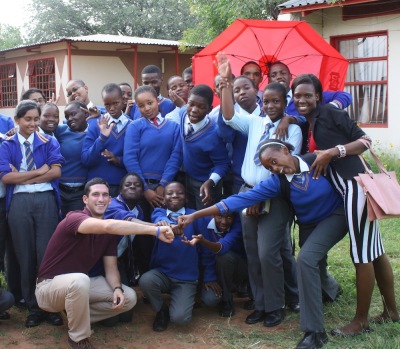
Youth Impact founders are teaching a "sugar daddy awareness" class to young girls in Botswana. The class warns teens about the increased HIV and pregnancy risks that come
SUGAR DADDY AWARENESS CHALLENGE; BOTSWANA
PROVEN INTERVENTION TO BE DISTRIBUTED
Sugar daddy awareness classes.
Learn more about the Sugar Daddy Awareness Challenge and how a simple, one-hour “sugar daddy awareness” training could help countless girls avoid pregnancy while still in school, which can lead to entrenched poverty, and build a better life.
DISTRIBUTION MODEL INNOVATION
As of 2011, Botswana had the second highest rate of HIV in the world. Despite numerous condom programs, free anti-retroviral drugs, national curricula emphasizing abstinence and other efforts to curb the spread of HIV, the disease remains pervasive.
Youth Impact (who won D-Prize as “Young 1ove” before changing their name) uses a four-pronged approach to connect youth to life-saving information about HIV. First, they find HIV education programs that work. Second, they centralize materials from effective programs on the website and at headquarters in Gaborone, Botswana. Third, they disseminate with four central approaches to remain effective: top down, grass roots, mass media, and institutional. Finally, they measure impact by making HIV surveys and assessments available and helping to administer them.
Youth Impact will scale the sugar daddy curriculum across Botswana, starting in Gaborone and selected villages, with a plan to reach 200 schools between March and May, 2014. In addition to making a suite of proven materials, they will also crunch the numbers. Their team has produced graphs from existing national HIV data in Botswana and they will supplement the sugar daddy material and make it relevant to the Botswana context.
PILOT AND SCALING GOALS
Reach 200 schools during the three month pilot phase
Reach 500 schools at the end of year 1
Conduct 2,000 sugar daddy workshops by the end of year 1
Decrease teenage pregnancy by 40% by the end of year 2
Decreasing HIV by 15% by the end of year 2
FOUNDING TEAM
Noam Angrist - Co-founder & Executive Director
Moitshepi Matsheng - Co-founder & Managing Director
Maisha Meds
Stanford and UC Berkeley students founded Miti Health. The venture is building an Android-based platform to help health care providers in East Africa streamline sales,
PATIENT IDENTIFICATION CHALLENGE; KENYA

PROVEN INTERVENTION TO BE DISTRIBUTED
Technology that provides high-quality, affordable, and consistent treatment for patients in the form of an android-based system that tracks sales, manages inventory, and automates reordering of pharmaceuticals.
Learn more about the Patient Identification Challenge and why identifying individuals in need of treatment suffering from health conditions such as obstetric fistula, cervical cancer, clubfoot, and cataracts which can be corrected with cost-effective interventions, could save lives.
DISTRIBUTION MODEL INNOVATION
Maisha Meds improves distribution of pharmaceutical medication in Kenya by developing and implementing a technology platform that supports pharmacists (called chemists in Kenya), nurses, and other healthcare providers to manage their business and make better choices as they reorder medication. Supply of pharmaceutical drugs can be difficult in Kenya, as distance to suppliers and intermittent communication pose challenges for the distribution of medication. With an estimated 1/3 of medication in East Africa being sub-standard or counterfeit, uncertainty about quality of medication supply chain creates additional complexity for providers hoping to stock high-quality medication.
In the first year of operation, with funding from Stanford University, Maisha Meds built a team of strategists, technologists, and implementers focused on building systems for scale; and the team has conducted extensive market research on the technology needs of the health sector in East Africa. Using the information from this research, the team has developed an Android-based application and we have begun testing it in chemist shops. The system includes the following components:
Android-based system that tracks sales, manages inventory, and automates reordering to streamline supply chains and optimize business practices
Technology systems and random spot-checks to monitor and provide information on quality of medication throughout the supply chain
Maisha Meds intends to pilot the cost-recovery sales model that they will use at scale, as well as test and refine the quality-control component in partnership with 3-5 small scale distributors of medication in Kenya. This model will include a monthly subscription service to pay for the tablet, application, stand, data plan, and warranty, as well as ad sales integrated into the application to partially fund management and overhead cost for the organization. For more, please see this fact sheet.
PILOT AND SCALING GOALS
Sell or lease the android system to 20 providers during the pilot phase
Sell or lease the android system to 200 providers at the end of year 1
Work in partnership with 10 distributors by the end of year 1
Randomly test 5% of medication available by the end of year 2
Operate in 15,000 chemist shops and clinics as well as serve over 200 suppliers in five countries in five years
FOUNDING TEAM
Jessica Vernon - Team Lead
Benjamin Jenson - Business Development
Tammu Guo - Product Development
Nick Singer - Operations
Margaret Mumbi - Special Projects
Michael Jurka - Technology
Are you ready to be the next great social entrepreneur?