Sollys Energy
Sollys Energy's mission is to end energy poverty in Malawi by making quality solar products affordable and accessible.
SOLAR LAMP CHALLENGE; MALAWI

PROVEN INTERVENTION TO BE DISTRIBUTED
Solar lamps.
Learn more about the Solar Lamp Challenge and how these lamps create enormous benefits for developing world families.
DISTRIBUTION MODEL INNOVATION
Sollys Energy's mission is to end energy poverty in Malawi by making quality solar products affordable and accessible.
The Sollys Energy business model involves the recruitment of sales agents located in the semi-urban areas of Lilongwe, Malawi. The sales agents are local shopkeepers and their customers may pay for the lanterns in installments through them, or through mobile money applications. The Sollys Energy team is a collection of young, unique, energetic individuals with diverse skill sets, and a common goal - eradicating energy poverty.
Sollys Energy was founded by Martin Masiya, Gift Bwanali, Nithaar Kaisi and Dickson Mervin Kapichi. All were students at the University of Malawi, The Polytechnic.
PILOT AND SCALING GOALS
Distribute 300 solar lamps during the three-month pilot, reaching 1,500 people
Raise an additional $45,000 during the three-month pilot
Reach 12,000 people at the end of year 1
Reach 65,000 people by the end of year 2
FOUNDING TEAM
Martin Masiya - CEO
Gift Bwanali - COO
Dickson Mervin Kapichi - CTO
Nithaar Kaisi - CMO
Katswiri
Katswiri's mission is to distribute livestock and livestock services on loan to rural smallholder farmers in order to promote a better quality of life.
CUSTOM CHALLENGE; MALAWI

PROVEN INTERVENTION TO BE DISTRIBUTED
Livestock market bundle.
Learn more about the Custom Challenge and why we only fund ideas that focus on distributing proven poverty interventions.
DISTRIBUTION MODEL INNOVATION
Katswiri's mission is to distribute livestock and livestock services on loan to rural smallholder farmers in order to promote a better quality of life.
The Katswiri distribution model is based on three part approach, that includes financing through the provision of livestock and livestock services on loan, training of rural farmers in livestock production best practices, and marketing support.
Katswiri’s plan is to provide long term sustainable livestock services to farmers in need and drive evidence-based impact.
PILOT AND SCALING GOALS
Enroll 100 households in livestock program within first six months
Directly distribute 1,400 livestock units, offer a series of 3 agriculture production trainings and vaccinate 1,400 livestock units
Raise 20,000 USD in first six months and then scale operations in the next year pilot to reach 450 farmers with an estimated fundraising budget of 100,000 USD
FOUNDING TEAM
Sopani R. Neba - Founder and Team Lead
Judith Kamanga - Training and Livestock Extension Specialist
Graciano Ulemu Gawamadzi - Project Management and Evaluation Specialist
Green Action One
Green Action One aims to reduce climate change effects in Malawi and beyond by distributing solar lights and other clean energy options to under-saved and marginalized populations.
SOLAR LAMP CHALLENGE; MALAWI

PROVEN INTERVENTION TO BE DISTRIBUTED
Solar lamps.
Learn more about the Solar Lamp Challenge and how these lamps create enormous benefits for developing world families.
DISTRIBUTION MODEL INNOVATION
Green Action One aims to reduce climate change effects in Malawi and beyond by distributing solar lights and other clean energy options to under-saved and marginalized populations. Green Action One is distributing solar lights in Malawi targeting southern region districts where rural teachers, health officers have benefited in larger numbers.
The model is centered on a network of sales agent in the community. Green Action One one will procure solar products and sell through farmer cooperatives, teachers center, health clinics, and village savings groups, using pay-as-you-go for customer financing to help people enjoy the benefits of clean energy.
PILOT AND SCALING GOALS
Reach 4,000 customers during the pilot
Distribute 26,000 solar lamps by the end of year 1
FOUNDING TEAM
Enock Palapandu - Co-founder
Christopher Said - Co-founder
Ella Liwonde - Co-founder
Agri Eco Enterprise (AEE)
Agri Eco Enterprise (AEE) aims to boost the lives of the small holder farmers in Malawi by distributing Purdue Improved Crop Storage (PICS) bags to address post-harvest loss.
CUSTOM AGRICULTURE CHALLENGE; MALAWI
PROVEN INTERVENTION TO BE DISTRIBUTED
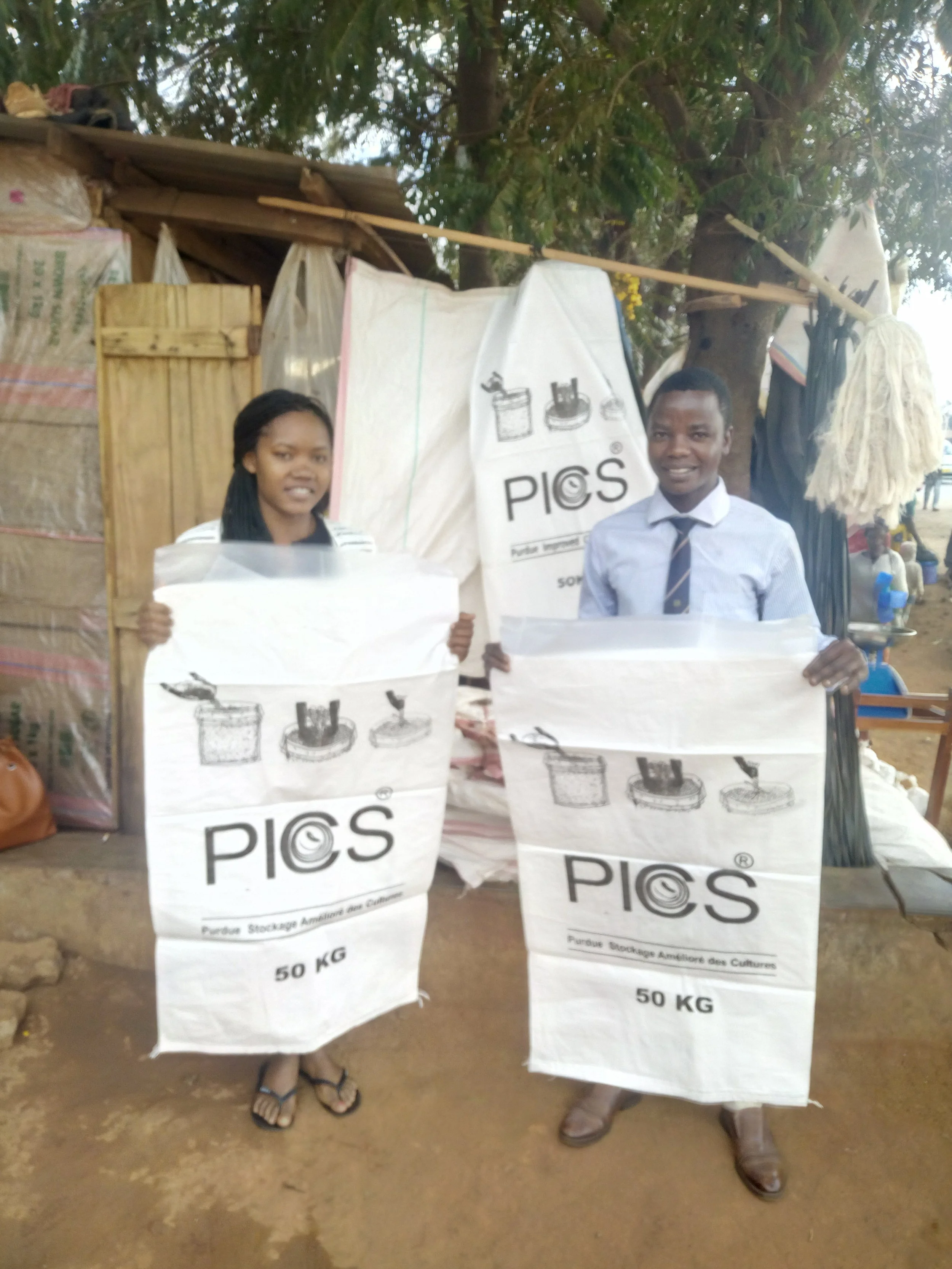
Purdue Improved Crop Storage (PICS) bags are a triple-layered plastic bag that serves as an air-tight storage method for harvested crops.
Learn more about the Custom Challenge and why we only fund ideas that focus on distributing proven poverty interventions.
DISTRIBUTION MODEL INNOVATION
Agri Eco Enterprise (AEE) aims to boost the lives of 100,000 Malawian smallholder farmers over the next few seasons through the distribution of Purdue Improved Crops Storage (PICS) bags in the districts of Dowa, Lilongwe, and Kasungu. Many enterprises focus on selling local bags, which are less effective.
AEE will recruit agents who will be distributing the PICS bags to smallholder farmers on commission basis. PICS will be supplied by poly pack Malawi Company which will be distributed to various agents in the targeted districts. The agents will be the shop owners who are already selling farm produces, seeds, pesticides, fertilizers and many others.
PILOT AND SCALING GOALS
Distribute 50,000 PICS bags in first three months
Reach 10,000 farmers with training and PICS bags in first three months
Reach 1 million farmers by Y5
FOUNDING TEAM
Ms. Joyce Sikwese - Executive Director
Mr. Sanderson Banda - Marketing Officer
WETECH Clean Lights Malawi
Waste and Energy Technologies (WETECH) limited proposes to distribute solar lamps through an innovative, sustainable, and scalable model that will help all Malawians access clean lighting.
SOLAR LAMP CHALLENGE; MALAWI

PROVEN INTERVENTION TO BE DISTRIBUTED
Solar Lamps.
Learn more about the Solar Lamp Challenge and how these lamps create enormous benefits for developing world families.
DISTRIBUTION MODEL INNOVATION
Waste and Energy Technologies (WETECH) limited proposes to distribute solar lamps through an innovative, sustainable, and scalable model that will help all Malawians access clean lighting and phone charging technologies. It is a direct response to the growing challenges by Malawians especially those on the base of the pyramid and those living in off grid communities. Out of the estimated population of 17 million in Malawi, only 10% are connected to an epileptic electricity grid. Out of the 10%, only 1% of the connected are in rural areas.
WETECH will be offering a unique solution that will be introduced to the market through targeted advertising, value added strategies and direct sales. The organization will form partnerships with companies looking to make large orders of solar lamps. WETECH envisages achieving direct sales through personal sales calls and direct visits to villages and customer premises.
PILOT AND SCALING GOALS
2,100 solar lamps sold through the 3 distribution routes during the pilot phase
Distribute 9,000 solar lamps by the end of year 1
FOUNDING TEAM
Edgar Bayani - Chief Executive Officer
Joan Nyirenda - Marketing Officer
Laurent Tito - Technical Services and Logistics
Mariane Chao Mwale - Finance Consultant
UP Scaling PICS Bags Technology
Their team will establish relationships with rural based farm input traders (agro dealers) and associations as outlets in Malawi so that farmers can easily access PICS bags instead of relying on central shops.
CUSTOM CHALLENGE; MALAWI
PROVEN INTERVENTION TO BE DISTRIBUTED
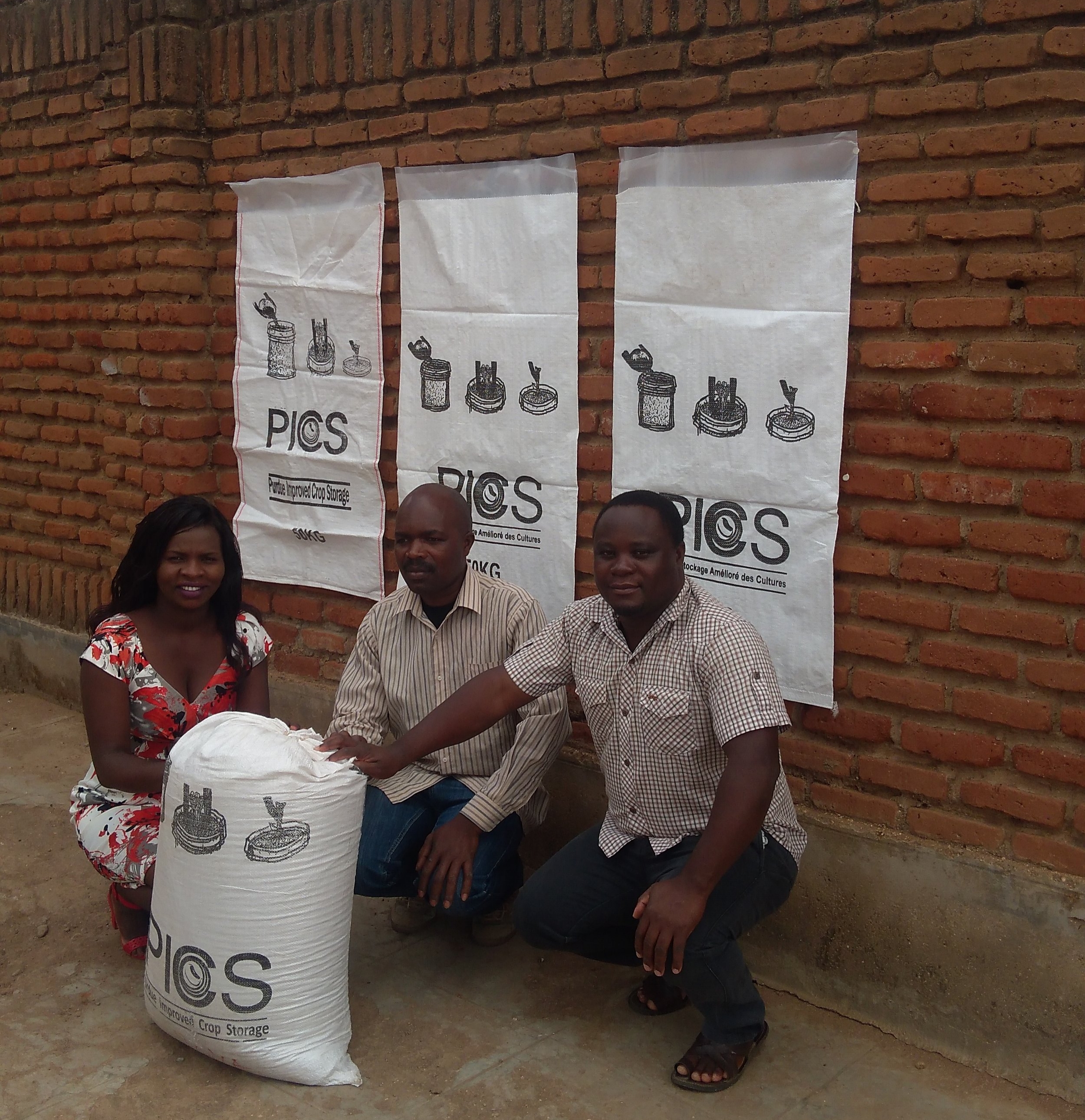
PICS post-harvest storage bags.
Learn more about the Custom Challenge and why we only fund ideas that focus on distributing proven poverty interventions.
DISTRIBUTION MODEL INNOVATION
Despite PICS bag Technology being very effective with up to 100% post-harvest loss reduction, the distribution chain in Malawi has been poor with limited players. There are 3 major barriers to accessing the technology: the distance from the production factory, limited players in the distribution chain, and generally a lack of knowledge amongst the farmers and agriculture extension workers on the availability of the technology and how it works.
The UP Scaling PICS Bags Technology team will establish relationships with rural based farm input traders (agro dealers) and associations as outlets so that farmers can easily access PICS bags instead of relying on central shops. That means the team will have selling points in rural trading centers. 5 selling points will be established. At each selling point, they will have a qualified extension worker responsible for on the spot demonstrations for farmers and agro dealers when they buy PICS bags. These will also be extension agents with designated impact areas where they will be working with farmers in demonstrating use and increasing awareness on the cost effectiveness of the bag. Agro dealers will be provided with training and awareness materials to increase valid sources of information. Each agro dealer through agriculture extension agents will have 10 anchor farmers to pilot and demonstrate effectiveness of PICS bags.
By the end of the pilot year, the team will sell 100,000 PICS bags and reach at least 20000 smallholder farmers, reducing post-harvest losses and contributing to poverty reduction through increased food and income.
As the organization scales, it will begin to distribute other impactful products including other high-quality seed and solar lamps.
PILOT AND SCALING GOALS
Sell 100,000 PICS bags by the end of year 1
Reach 20,000 smallholder farmers with information by the end of year 1
Reach over 100,000 grain growers and consumers by the end of year 5
FOUNDING TEAM
Kondwani Khonje - Manager
Prisca Gondwe - Accountant
Impact Light Solar Trading
Impact Light Solar Trading will distribute solar lamps in urban and semi-urban areas of Malawi, beginning with a pilot in Ndirande Township in the city of Blantyre.
SOLAR LAMP CHALLENGE; MALAWI

PROVEN INTERVENTION TO BE DISTRIBUTED
Solar lamps.
Learn more about the Solar Lamp Challenge and how these lamps create enormous benefits for developing world families.
DISTRIBUTION MODEL INNOVATION
Impact Light Solar Trading will distribute solar lamps in urban and semi-urban areas of Malawi, beginning with a pilot in Ndirande Township in the city of Blantyre. Their motivation comes from the observation that solar lamp distribution in Malawi often targets rural areas, yet urban and semi-urban residents in Malawi experience massive blackouts, sometimes lasting as long as 25 hours at a stretch.
Their approach for the distribution of the solar lamps is centered on creating awareness of and demand for the products while ensure that solar lamps are available at an affordable price. Solar lamps will be retailed directly by Impact Light Solar, Village Savings and Loans groups, and sales agents identified by Impact Light Solar. By selling through Village Savings and Loans groups, the venture will be able to reach a majority of women and easily implement a pay-as-you-go purchasing model.
PILOT AND SCALING GOALS
Distribute 500 solar lamps during the pilot
Distribute 1,500 solar lamps at the end of year 1
Reach 15,000 people at the end of year 1
Distribute 3,500 solar lamps by the end of year 2
Reach 30,000 people by the end of year 2
FOUNDING TEAM
Precious Chaponda - Trading Manager
Edward Governor - Communications and Marketing Manager
Amakhosi Humphrey Jere - Business Development Advisor
Patsogolo Ndi Ulimi
To address the problem of soil fertility, Patsogolo ndi Ulimi project will increase the yields of smallholder farmers by over 70% and promote a green environment through the promotion of fertilizer microdosing.
FERTILIZER CHALLENGE; MALAWI

PROVEN INTERVENTION TO BE DISTRIBUTED
Fertilizer and microdosing technique.
Learn more about the Fertilizer Challenge and why increasing the effective use of fertilizer has the potential to unlock significant crop yield for smallholder farmers in sub-Saharan Africa.
DISTRIBUTION MODEL INNOVATION
Land degradation in the Southern Africa region has substantial environmental, social and economic costs. The majority of Malawians live in rural areas and depend on agriculture for their livelihoods. National surveys estimate that crop production accounts for 74 percent of all rural incomes. Unless nutrients are replaced, soils become depleted, causing the yields and crop quality to decline (ICRISAT 2009). However, farmers are often unable to invest in soil nutrients because they are increasingly costly and often inaccessible. Knowledge among smallholder farmers about what inputs to use and how to apply them effectively is limited. Malawian farmers uses a small amount of fertilizer which is applied to only a portion of their land, perpetuating the significant soil nutrient deficiencies leading to low yields.
To address the problem of soil fertility, Patsogolo ndi Ulimi project will increase the yields of smallholder farmers by over 70% and promote a green environment through the promotion of fertilizer microdosing. This is a highly efficient technique that minimizes the application of and over – reliance on chemical fertilizer. It involves the application of small quantities of fertilizer onto or close to the seed.
The project will use an innovative education method of lead farmers approach to distribute the technology to reach farmers. Lead farmers are progressive farmers (community volunteers) in the community that pilot different innovations on their farms while teaching other farmers in the process. One lead farmer has an average of 20 farmers that learn from his farm.
PILOT AND SCALING GOALS
- Recruit 100 lead farmers by the end of year 1
- Reach 2,000 farmers with fertilizer microdosing training by the end of year 1
- Recruit 500 lead farmers by the end of year 5
- Reach 10,000 farmers by the end of year 5
FOUNDING TEAM
Madalitso Chidumu - Team Lead and Founder
Hope Mpata - Extension Delivery Service Lead
Chimwemwe Mkandawire - Finace Lead
Green Impact Technologies (GI-Tech)
Green Impact Technologies will distribute Pico Solar Lights through Green Wing Finance Capital customers in communities located in the last mile in Malawi.
SOLAR LAMP CHALLENGE; MALAWI

PROVEN INTERVENTION TO BE DISTRIBUTED
Solar lamps.
Learn more about the Solar Lamp Challenge and how these lamps create enormous benefits for developing world families.
DISTRIBUTION MODEL INNOVATION
Malawi is the least electrified country in the Southern Africa Developing Community with less than 10% of the population having access to electricity in 2016. Only 4% of rural households have access to electricity. In the district of Usingini, most shops and homes use flashlights, kerosene, and candles for lighting while some walk approximately 18km to charge their phones.
Green Impact Technologies orders solar products from Solar Aid. This enterprise has a memorandum of understanding with Green Wing Capital which sells Solar Aid products to 25,000 customers. Customers pay 70% of the cost of the solar product upfront to Green Wing but are required to pay the remaining 30% the following month. GI-Tech delivers the solar product stock to Green Wing and pays for the remaining 30%, utilizing this distribution channel to reach last mile communities and build longer term relationships with sales agents in the area.
PILOT AND SCALING GOALS
- Reach 1,500 households within the pilot phase
- Establish 10 businesses by the end of year 1
- Reach 7,500 people by the end of year 1
FOUNDING TEAM
Admore Chiumia - Managing Director
Are you ready to be the next great social entrepreneur?