HERVeg.05
HERVeg.05 empowers women and youth in rural Tanzania to fight malnutrition and poverty through a climate-smart, integrated farming model that improves nutrition, income, and resilience.
CUSTOM AGRICULTURE CHALLENGE; Tanzania

PROVEN INTERVENTION TO BE DISTRIBUTED
Quality inputs, and technical training
Learn more about the Custom Agriculture Challenge and why distributing proven agricultural interventions can greatly improve the livelihoods of smallholder farmers.
DISTRIBUTION MODEL INNOVATION
HERVeg.05 empowers women and youth in rural Tanzania to fight malnutrition and poverty through a climate-smart, integrated farming model that improves nutrition, income, and resilience.
HERVeg.05 works with local Village Savings and Loan Associations (VSLAs) in rural Tanzania to deliver high-quality poultry, biofortified maize, and vegetable seeds directly to farmers, alongside hands-on training in nutrition and sustainable farming. By using a mobile layaway system, farmers can save as little as $1 to access essential inputs, making the model affordable even with seasonal incomes.
One thing that sets HERVeg.05 apart is its smart integration of poultry, crops, and vegetables, where manure boosts crop yields, crop leftovers feed chickens, and the loop improves health and income. Their last-mile delivery approach ensures even remote farmers are included without extra cost. The pilot is currently underway in Tanzania, with a scalable model designed for broader African markets.
HERVeg.05 was founded by Ibrahim Islam, a passionate advocate for climate-smart agriculture and youth empowerment in rural Tanzania. Ibrahim brings a strong background in agricultural innovation, community engagement, and impact-driven entrepreneurship. He leads the venture’s vision, operations, and growth strategy on the ground.
PILOT AND SCALING GOALS
Directly reach 600 smallholder farmers, especially women and youth, within three months.
Through 25 local village agents, distribute 3000 one-month fully vaccinated SASSO chickens, 400kg of vegetable seeds and 2 tons of biofortified maize in three months.
Fundraise an additional USD 45,000 from new donors.
FOUNDING TEAM
Ibrahim Islam - C.E.O. and Founder
Kilimo-Premier Financial Services Limited
Kilimo-Premier Financial Services Limited aims to be among the leading financial services providers within the country that improve smallholder farmers’ livelihoods through the provision of agro-credit services
CUSTOM AGRICULTURE CHALLENGE; Tanzania

PROVEN INTERVENTION TO BE DISTRIBUTED
Improved seeds, and fertilizer, training on agronomic practices, finance for farm inputs, and market facilitation
Learn more about the Custom Agriculture Challenge and why distributing proven agricultural interventions can greatly improve the livelihoods of smallholder farmers.
DISTRIBUTION MODEL INNOVATION
Kilimo-Premier Financial Services Limited aims to be among the leading financial services providers within the country that improve smallholder farmers’ livelihoods through the provision of agro-credit services.
Their model is called the Modified Grameen Model, where solidarity groups guarantee loans and repayment settled on increments at any time within six months. Smallholder farmers join solidarity groups of 5 members called Enterprise Group (EG) and 10 EG form large groups of 50 members called Market Enterprise Committee (MEC). Members in groups will guarantee each other by using their farm fields, so group credit monitoring is the member’s responsibility.
The model reduces the difficulties in loan administration and developing guarantees, the loan services are provided in bundle bases including distribution of improved seeds, and fertilizer, training on agronomic practices, finance for farm inputs, and market facilitation to maximize profits. The MEC members make the final decision on approving loans because they are loan guarantors. The loan repayment will be done on a weekly basis during MEC meetings.
Kilimo Premier Financial Services Limited was founded in 2023 by Kataga Daniel Ngulinzira and Grace Manyama Shadrack. The team members have experience in different professions, Kataga has been an expert in agribusiness sectors for more than 10 years, and Grace is in financial management and baking. Grace serves as the company's full-time Financial and Administrative Director, and Mr. Kataga serves as Managing Director. The company expects to recruit one full-time Loan and Training Officer after its commencing for field work.
PILOT AND SCALING GOALS
150 smallholder farmers directly reached within three months.
3Market Enterprises Committees (MEC) and 30 Enterprises Groups (EG) mobilized and facilitated by agronomic practices and agro-loans.
Fundraise an additional fund of $ 10,000 from donors/investors within three months.
FOUNDING TEAM
Kataga Daniel Ngulinzira - Managing Director
Grace Manyama Shadrack - Financial and Administrative Director
Sesa Energy
SESA Energy's mission is to provide affordable, reliable, and sustainable solar power solutions to illuminate and power underserved communities in Tanzania while empowering local women and youth, reducing carbon emissions, and fostering economic prosperity.
SOLAR LAMP CHALLENGE; Tanzania

PROVEN INTERVENTION TO BE DISTRIBUTED
Solar Lamps
Learn more about the Solar Lamp Challenge and how these lamps create enormous benefits for developing world families.
DISTRIBUTION MODEL INNOVATION
Sesa Energy's mission is to provide affordable, reliable, and sustainable solar power solutions to illuminate and power underserved communities in Tanzania while empowering local women and youth, reducing carbon emissions, and fostering economic prosperity.
Sesa Energy's distribution model is uniquely designed to bridge the energy access gap in Tanzania by extending from urban areas to the most remote rural regions. What sets them apart is their strong emphasis on empowering local women and youth who become integral parts of their distribution network as sales agents and franchisees.
This not only creates economic opportunities within communities but also ensures that Sesa Energy reaches the farthest corners of Tanzania, making clean energy solutions accessible and affordable to even the poorest rural populations.
The pilot project is based in Ngorongoro, Monduli, and Longido, areas that typically face significant energy poverty, and Sesa Energy’s commitment to local empowerment through its distribution network sets it apart as a socially impactful energy provider.
Sesa Energy was started in 2022 by Joshua Joseph Msechu, Eva Joseph Msechu, and Sabrina Daudi Kinga. Joshua serves as the Project Leader and a Co-Founder, and Eva and Sabrina are Co-Founders.
PILOT AND SCALING GOALS
Directly reach up to at least 2500 people within the first three months.
Using 10 distribution agents, they will distribute 500 lamps in three months.
Fundraise an additional $10000.
FOUNDING TEAM
Joshua Joseph Msechu - Project Leader and Co-Founder
Eva Joseph Msechu - Co-Founder
Sabrina Daudi Kinga - Co-Founder
Ibukia Shambani
Ibukia Shambani innovates access to the most comprehensive, quality, and productive agricultural inputs to smallholder last-mile farmers.
QUALITY INPUTS CHALLENGE CHALLENGE; TANZANIA

PROVEN INTERVENTION TO BE DISTRIBUTED
Quality seeds, fertilizer, and post-harvest storage bags to smallholder farmers
Learn more about the Improved Farm Practices Challenge and why increasing the effective use of fertilizer has the potential to unlock significant crop yield for smallholder farmers in sub-Saharan Africa.
DISTRIBUTION MODEL INNOVATION
Ibukia Shambani innovates access to the most comprehensive, quality, and productive agricultural inputs to smallholder last-mile farmers.
The social agribusiness enterprise was founded in 2022 by Abdallah Mabrouck, alongside two co-founders, Ayubu Mundekesye and Kelvin Robert. Both team members are experts in the agribusiness sector and have a passion for developing the agricultural sector as a whole.
PILOT AND SCALING GOALS
Directly reach 100 smallholder farmers at last mile prior to the planting season
Distribute 1 ton of quality maize seeds, 2.5 tons of DAP, 2.5 tons of UREA, and 100 liters of acetic acid as quality inputs to smallholder farmers in three months
Fundraise an additional $10,000 from other interested partners and donors in three months
FOUNDING TEAM
Abdallah Mustapha Mabrouck - Project Lead
Ayubu Eliah Mundekesye - Business Development Lead
Kelvin Robert Mwise - Credit Management Lead
RUMO Energy
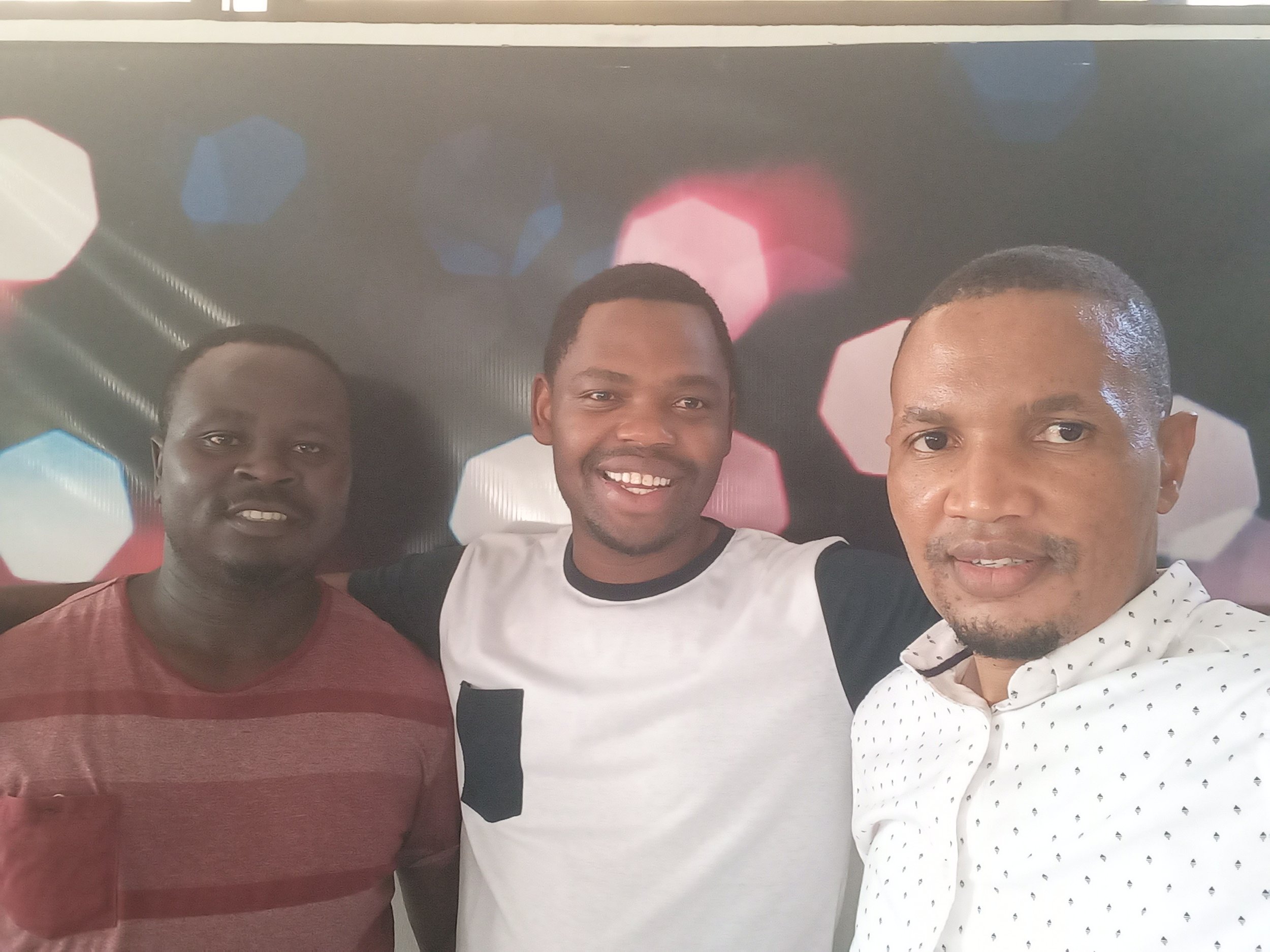
RUMO Energy increases the distribution of solar lamps in rural Tanzania through the rent-to-own model.
SOLAR LAMP CHALLENGE; TANZANIA
PROVEN INTERVENTION TO BE DISTRIBUTED
Solar lamps.
Learn more about the Solar Lamp Challenge and how these lamps create enormous benefits for developing world families.
DISTRIBUTION MODEL INNOVATION
RUMO Energy increases the distribution of solar lamps in rural Tanzania through the rent-to-own model.
Their model is based on a competitive rent-to-own distribution through local entrepreneurs. The program targets entrepreneurs with influence and working together on mutually beneficial to support them to serve more people in their community. The RUMO Energy model is the best model to produce critical distribution networks in rural areas in Tanzania.
RUMO Energy was started on March 1, 2021, by Patrick Mkoma, Heri Marco and Sefania Amnon.
PILOT AND SCALING GOALS
Directly reach 350 customers within three months
Use 26 distribution agents, distribute 350 lanterns in three months
Fundraise an addition of $30,000 from new donors and investors within three months
FOUNDING TEAM
Patrick Mkoma - Sales, Marketing & Revenue
Heri Marco - Business Development & Government Logistics
Sefania Amnon - Sales & Business Relationship
Samuel Mshana - Project Engineer & Technician
Wezesha
Wezesha is a digital communication platform for the primary healthcare sector, which uses accessible technology to enhance two-way communication between patients, service providers and government institutions.
TRANSPARENCY CHALLENGE


PROVEN INTERVENTION TO BE DISTRIBUTED
A digital platform that enhances two-way communication in the healthcare sector between patients, service providers, and government institutions.
Learn more about the Transparency Challenge and how citizen reporting platforms can be used to hold government officials accountable and reduce corruption.
DISTRIBUTION MODEL INNOVATION
Wezesha is a digital communication platform for the primary healthcare sector, which uses accessible technology to enhance two-way communication between patients, service providers and government institutions. As a patient arrives at the clinic they are prompted to register on Wezesha through their mobile phone using USSD technology. After receiving services at the clinic, the patient will be prompted by Wezesha to respond to <5 questions relating to their experience. For example, a patient seeking antenatal care may be asked to rate the quality of the service provided by responding to specific questions about their interaction with the care provider.
Wezesha aggregates this digital data over time and across geographic areas to analyse how patient experience differs. Data is shared with partners in government and service providers, who can then make decisions on how to adjust service provision. This becomes a major lever for improving service quality and patient experience. Once this digital communication channel is established between Wezesha and patients, government and service providers can use this as an outbound channel to directly reach patients. For example, a patient with a chronic condition who needs to return to the facility regularly, can receive a digital prompt via SMS.
This solution is based on evidence provided from research which indicates that improving data, communication and strengthening systems of accountability within primary healthcare leads to enhanced citizen experience and healthcare outcomes.
PILOT AND SCALING GOALS
Partner with 3-5 primary healthcare facilities in the first three months
1,000 citizen engagements in the first three months
Operate within 100 primary healthcare facilities by end of year 2
500,000 citizen engagements by end of year 2
Expand into two additional countries and/or sectors by end of year 5
FOUNDING TEAM
Simon DeBere - Co-founder
Robert Smith - Co-founder
Community Technology Worker Program
To transition families to LPG stoves from firewood and charcoal, the Community Technology Worker (CTW) Program trains local experts in Shirati, Tanzania to teach families how to use the gas stove, check in regularly, and provide any technical or maintenance support to the households.
COOK STOVE CHALLENGE; TANZANIA

PROVEN INTERVENTION TO BE DISTRIBUTED
Cook stoves.
Learn more about the Cook Stove Challenge and how clean cook stoves reduce health and safety risks, lower fuel expenses, and help reduce poverty.
DISTRIBUTION MODEL INNOVATION
To transition families to LPG stoves from firewood and charcoal, the Community Technology Worker (CTW) Program trains local experts in Shirati, Tanzania to teach families how to use the gas stove, check in regularly, and provide any technical or maintenance support to the households.
A Community Technology Worker teaches the family how to use the stove safely, leaves resources and their phone number in case there are issues, and revisits to check in. The Community Technology Worker thus provides a three-fold objective to help transition the family: to help with any technical issues, to remind the family to be saving up for the next cylinder, and to reinforce and encourage the adoption of gas.
The program buys the initial stove, pays the CTW, and empowers the families to refill on their own by changing their saving mechanisms around cooking fuel. The CTW model stands out as it relies on community-based empowerment to reach households. This intervention of CTW is about people in the community supporting their community. Every barrier the community faces, the CTWs address it, listen, and adapt.
PILOT AND SCALING GOALS
Reach 500 during Step-Wedge Cluster Randomized Controlled Trial with 1 LPG stove per family
Hire and onboard 15 Community Technology Workers
Track LPG adoption metrics through a yearlong study
FOUNDING TEAM
Annelise Gill-Wiehl - Co-Founder
Fred Chacha - Co-Founder
Nayome Aguttu- Co-Founder
Mary Frances - Co-Founder
Con-Com
Con-Com will utilize the network of home based care workers (HBCs) who currently work on HIV treatment to help ensure that more women living in rural areas of Tanzania are screened for cervical cancer.
PATIENT IDENTIFICATION CHALLENGE; TANZANIA

PROVEN INTERVENTION TO BE DISTRIBUTED
Cervical cancer screenings.
Learn more about the Patient Identification Challenge and why identifying individuals in need of treatment suffering from health conditions such as obstetric fistula, cervical cancer, clubfoot, and cataracts which can be corrected with cost-effective interventions, could save lives.
DISTRIBUTION MODEL INNOVATION
Con-Com will utilize the network of home based care workers (HBCs) who currently work on HIV treatment to help ensure that more women living in rural areas are screened for cervical cancer. HBCs will alert women to screening services, including on days when the cervical cancer team travels on outreach to villages, and refer patients to screening services. HBCs will also distribute stipends covering transportation fees for women to enure they can reach screening services. Finally, HBCs will help overcome gender barriers by having a male HBC explain the value of screening to men to encourage husbands to support wives when they are screened.
Con-Com will implement their intervention at Shirati Hospital, a district hospital serving over 250,000 people, and located five hours from the nearest referral hospital in Mwanza, Tanzania. Poverty and distance mean that women often do not hear about the screening services available at Shirati Hospital or cannot afford the cost of transport. Con-Com will focus on providing awareness of the benefits and screening and treatment, a stipend to pay for transport to screening services, and assistance in convincing their husband's to allow patients to receive treatment. Additionally, patients are in need of checkups post procedure if they start presenting symptoms. HBCs working with Con-Com will also take on this role.
PILOT AND SCALING GOALS
120 women screened during the pilot
3 women referred to the referral hospital for treatment during the pilot
360 women screened by the end of year 1
600 women screened by the end of year 2
60 women referred to the referral hospital for treatment by the end of year 2
FOUNDING TEAM
Luke Maillie - Founder
Jibu Tanzania
Jibu Tanzania aims to tackle two major issues within East Africa and beyond: unemployment and lack of access to clean water. Their mission is to create affordable access to drinking water through franchised water production sites across Arusha.
CUSTOM CHALLENGE; TANZANIA

PROVEN INTERVENTION TO BE DISTRIBUTED
Improving access to clean water through distribution.
Learn more about the Custom Challenge and why we only fund ideas that focus on distributing proven poverty interventions.
DISTRIBUTION MODEL INNOVATION
Jibu Tanzania aims to tackle two major issues within East Africa and beyond: unemployment and lack of access to clean water. Their mission is to create affordable access to drinking water through franchised water production sites across Arusha. They will do this by having a water purification machine serving 50,000 people with an associated network of 10 local micro-resellers within an area of 2 kilometers around the production center.
A 2010 demographic and health survey states that 60% of Tanzanians do nothing to treat their water. Most households have no home filtration system and many drink unboiled water. Water is sourced from house taps and outdoor standpipes and has a high concentration of fluoride which, when consumed long-term, can lead to severe physical ailments. Chlorine or sand filters alone do not remove fluoride and other harmful micro-biological pathogens.
Jibu employs reverse osmosis as a water treatment method which allows for all harmful bacteria and parasites to be filtered out as well as 95% of floride. The water will be packaged, sold, and distributed in re-usable containers. Jibu partners with Healing Water International to access water filtration units as they do not manufacture their own. The secret to their prices is the efficiency of a decentralized, hyper-local business model because their focus is on underserved populations living in close proximity of each Jibu storefront.
PILOT AND SCALING GOALS
Serve 600 customers during the pilot
Serve 4,000 customers at the end of year 1
Sell 800 liters of water during the pilot
Sell 5,333 liters of water at the end of year 1
FOUNDING TEAM
Tayeb Noorbhai - Managing Director
Alex van Praag - Operations Manager
Bonaventure Bernard - Sales and Business Development
Giacomo - Marketing and Franchise Officer

KopaGas
We expand access to clean cooking fuel by letting people pay as you to switch from cooking with charcoal. Our model is working in urban areas in Dar es Salaam and now the real challenge is adapting it so we can serve the very poorest in rural areas.
CUSTOM CHALLENGE; TANZANIA

PROVEN INTERVENTION TO BE DISTRIBUTED
A smart meter to enable micro payments on LPG gas for low-income, rural households.
Learn more about the Custom Challenge and why we only fund ideas that focus on distributing proven poverty interventions.
DISTRIBUTION MODEL INNOVATION
KopaGas is a pioneer on pay-as-you-go LPG for low-income settings.
Of low-income households in rural Tanzania, 60% want to switch to LPG they can't afford due to upfront costs. KopaGas has developed a smart meter that enables micro-payments for LPG and has demonstrated success in Dar es Salaam. By developing credit-risk scores for low-income rural households, they can bring the technology to rural Tanzanians and help millions access modern cooking fuel. The team will build off of existing infrastructure and community presence in the fishing community on Jibondo island.
Using human-centered design to create impactful behavioral change marketing campaigns, KopaGas will improve awareness of the benefits of LPG and introduce the community to a pay-as-you-cook solution enabled by a fully functional and mass-manufacture ready smart meter. This is the only commercially-ready smart meter for LPG in East Africa and will be combined with a credit-scoring methodology that they will research and design to create access for the poorest families.
PILOT AND SCALING GOALS
Deliver over 50 tons of LPG during the pilot phase
Connect 400 households during the pilot phase
Reach over 8,000 people by the end of year 1
Avoid 6,000 tons of carbon dioxide emitted by the end of year 2
Avert 381 deaths from smoke inhalation by the end of year 2
FOUNDING TEAM
Thomas Disley - Project Lead
Sebastian Rodriguez - KopaGas Chief Executive Officer and Product Lead
Andron Mendes - KopaGas Chief Financial Officer
Juabar
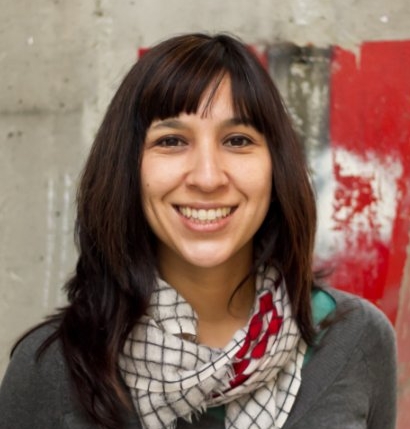
Olivia launched Juabar in Tanzania. Juabar kiosks use solar power to charge mobile phones and are also a point-of-sale for household solar lamps. Kiosks are run by local “jua-preneurs”.
CUSTOM CHALLENGE; TANZANIA
PROVEN INTERVENTION TO BE DISTRIBUTED
Juabar, a design-build start-up, creates transportable mobile-phone charging kiosks powered by a 40-60W solar system for use in rural and urban areas that lack access to electricity.
Learn more about the Custom Challenge and why we only fund ideas that focus on distributing proven poverty interventions.
DISTRIBUTION MODEL INNOVATION
Turning Juabar kiosks into solar light enterprises run by "Juapreneurs" can act as an extremely effective means for overcoming the traditional distribution barriers faced in Tanzania for numerous reasons:
The market for Juabar kiosks directly correlates with that of solar lights - in areas of Tanzania that are not electrified. Juabar provides needed phone charging services and solar lights are a complementary product offering for this market.
The kiosks provide a working example to potential consumers of the effectiveness of solar power thorugh the charging of their phones. This overcomes the hesitation that a consumer often has when met with a new product such as solar technology. In addition to handing out marketing materials, promotion will come when routine charging customers repeatedly interact with lighting products and the kiosk operators who can promote their benefits.
A portable kiosk allows operators to bring their service and products to the consumer. With its large, unique structure, Juabar sticks out in every setting and word-of-mouth about its presence travels quickly in isolated rural areas. Phone costs can represent up to 25% of the annual income of someone with poor energy access, with up to 50% of these costs going to travel expenses in getting to a charging location. Kiosks reduce these travel costs and can directly show consumers an option for further reducing ongoing household energy costs.
PILOT AND SCALING GOALS
- Create 15 solar lighting Juapreneurs by the end of the 3 month pilot
- Serve 4,000 households with charging services during the 3 month pilot
- Roll out 150 Juabar lighting dealers by the end of year 2
- Reach 26,650 households by the end of year 2
FOUNDING TEAM
Olivia Nava - Co-Founder
Last Mile
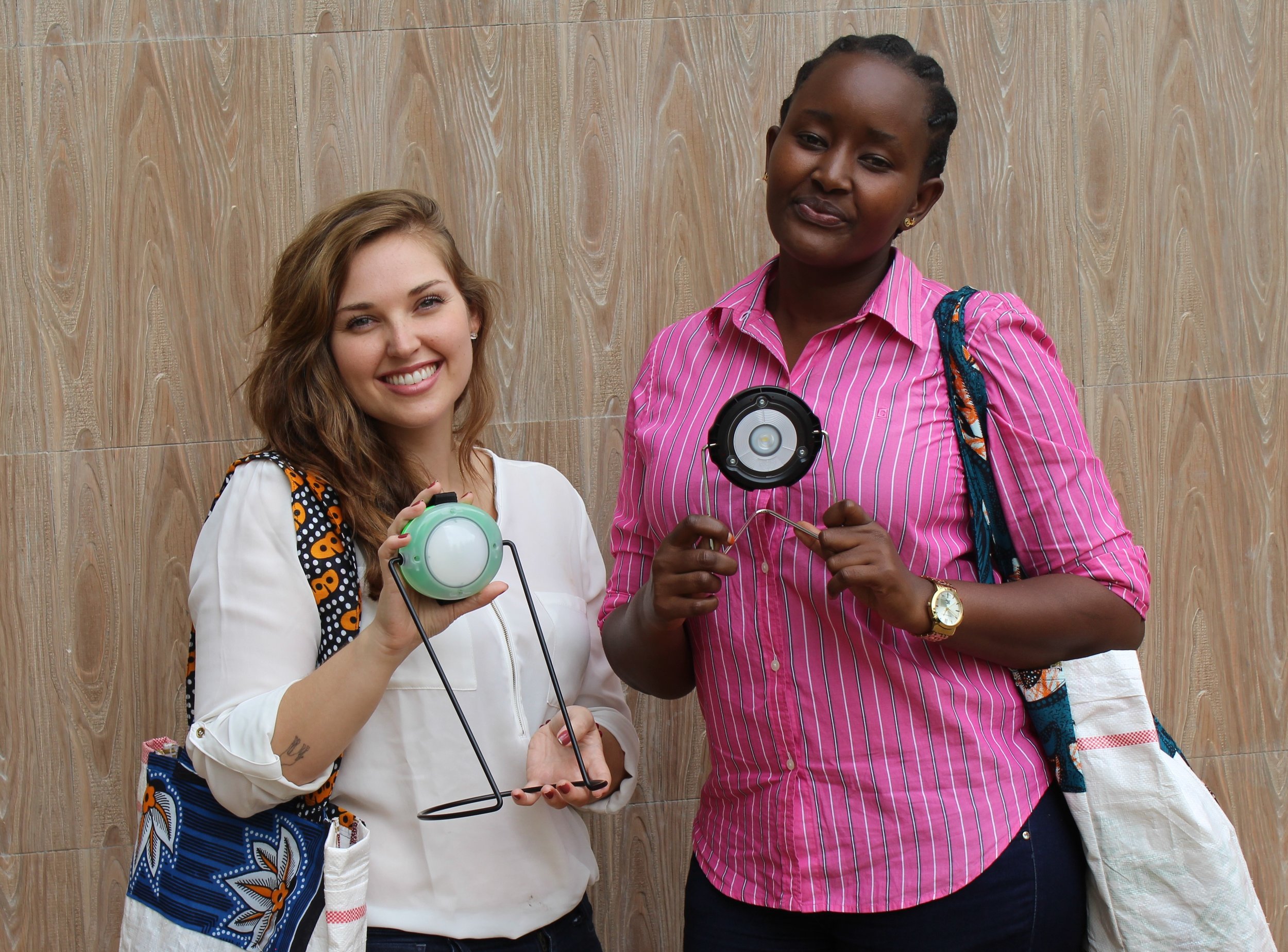
Last Mile is a new social enterprise founded by Liz McNeil and her team at Anza. Over the next three months, the Last Mile pilot will train 25 high-performing sale agents in the
SOLAR LAMP CHALLENGE; TANZANIA
PROVEN INTERVENTION TO BE DISTRIBUTED
Solar lamps and other impact products and services to be distributed through a network of trained and respected local sales agents to improve access.
Learn more about the Solar Lamp Challenge and how these lamps create enormous benefits for developing world families.
DISTRIBUTION MODEL INNOVATION
Last Mile is creating a strong distribution network of sales women which will be responsible for selling the products to various end consumers. They recruit and train sales agents to be both knowledgeable experts in the usage and benefits of the products as well as reliable and trusted resources in their communities. Sales agents are equipped with sales, health, and product knowledge through a comprehensive training program, as well as a basket of sample products and services which are based on proven local needs. Last Mile will begin with a limited number of products available to allow sales agents to develop their skills: AFRIpads, a brand of reusable sanitary pads; Virutubishi, a micro-nutrient powder supplement created specifically based on the average Tanzanian diet; iCHF, a government-matched health and medical insurance, and two solar products from the Greenlight Plant Sun King product line.
A main office in the Moshi Municipal district of the Kilimanjaro region allows for easy access routes to consumers in urban, rural, and peri-urban wards. Training programs are hosted out of the office. Monthly refresher trainings are an opportunity for sales network to restock, learn about new products or sales strategies, and offer an environment for agent-run support meetings.
PILOT AND SCALING GOALS
- Train 25 high-performing sales agents during the pilot
- Distribute over 500 quality, affordable solar lamps and other products during the pilot
- Create over 4,000,000Tsh in local income during the pilot
- Distribute 7,678 products by year 1
- Impact 24,798 people by year 1
FOUNDING TEAM
Liz McNeil - Managing Director
Nina Mairo - Sales Manager and Trainer
Are you ready to be the next great social entrepreneur?