Phindu Enterprise
Phindu Enterprise's mission is to help smallholder farmers escape poverty by providing post-harvest financing and market access solutions that enable them to capture the full value of their harvests.
Post-Harvest Support CHALLENGE; Malawi

PROVEN INTERVENTION TO BE DISTRIBUTED
Post-Harvest Support
Learn more about the Post-Harvest Support Challenge and why an evidence-based model that distributes post-harvest loans and improved grain storage bags could reliably boost the standard of living for smallholder farmers.
DISTRIBUTION MODEL INNOVATION
Phindu Enterprise's mission is to help smallholder farmers escape poverty by providing post-harvest financing and market access solutions that enable them to capture the full value of their harvests.
Phindu Enterprise will launch its pilot in Dowa District, Malawi, working through existing farmer groups, cooperatives, and lead farmers to identify and onboard participants. Farmers will receive post-harvest cash advances secured against their crops, which will be aggregated, safely stored, and collectively marketed during the lean season when prices are highest. Their community-based approach builds trust by leveraging local relationships and ensuring farmers remain active partners throughout the process. What sets the venture apart is its integrated model that combines financing, storage, and market access into one solution, enabling farmers to meet immediate cash needs without sacrificing future income.
Phindu Enterprise was founded in 2025 by Aaron Bryce Chawiya, Founder and Executive Lead, and Constance Kalikwembe, Co-Founder and Coordinator of Field Operations. Spencer Bandawe joins the team as a Learning and Impact Lead.
PILOT AND SCALING GOALS
Directly reach 150 smallholder farmers within three months.
Distribute 300 PICS Bags and 150 cash advances to 150 smallholder farmers within three months.
To raise additional USD25000 during the pilot period
FOUNDING TEAM
Aaron Bryce Chawiya - Founder and Executive Lead
Constance Kalikwembe - Co-Founder and Field Operations Lead
Harvest Guard Solutions (HGS)
Harvest Guard Solutions (HGS)’s mission is to empower smallholder farmers with affordable, innovative post-harvest technologies and pre-harvest financial support, reducing food losses, enhancing food security, and increasing household incomes.
Post-Harvest Support CHALLENGE; Malawi

PROVEN INTERVENTION TO BE DISTRIBUTED
Post-Harvest Support
Learn more about the Post-Harvest Support Challenge and why an evidence-based model that distributes post-harvest loans and improved grain storage bags could reliably boost the standard of living for smallholder farmers.
DISTRIBUTION MODEL INNOVATION
Harvest Guard Solutions (HGS)’s mission is to empower smallholder farmers with affordable, innovative post-harvest technologies and pre-harvest financial support, reducing food losses, enhancing food security, and increasing household incomes.
HGS’s model combines affordable post-harvest technologies with pre-harvest financial support, delivered through local Village Savings and Loan Associations. Trained village agents manage groups of farmers, ensuring accountability and facilitating payments, while farmers access PICS bags and small loans to protect their harvests. This integrated approach strengthens local distribution networks, reduces post-harvest losses, and increases incomes, providing a scalable framework for expansion beyond the pilot.
The HGS team includes Vanex Kamanga, Charity Manyowa, and Elizabeth Phiri, each playing a key role in the organization. Vanex will lead overall operations, coordinate farmer engagement, and ensure effective distribution of PICS bags. Charity will manage market strategies, farmer training programs, and support VSLAs to strengthen local networks, while Elizabeth will oversee financial management, pre-harvest loans, and repayment systems. Together, they will implement the pilot in Dowa District, directly engaging farmers and building a scalable model to reduce post-harvest losses and improve rural livelihoods.
PILOT AND SCALING GOALS
Directly reach 500 smallholder farmers within three months.
Using 4 high-performing distribution agents, distribute 5,000 PICS bags and pre-harvest loans in three months.
Raise $7800 in additional funding.
FOUNDING TEAM
Vanex Ian Kamanga - Founder
CornHouse
CornHouse’s mission is to uplift Cameroonian rural maize farmers through better storage, finance and market access.
Post-Harvest Support CHALLENGE; Cameroon

PROVEN INTERVENTION TO BE DISTRIBUTED
Post-Harvest Support
Learn more about the Post-Harvest Support Challenge and why an evidence-based model that distributes post-harvest loans and improved grain storage bags could reliably boost the standard of living for smallholder farmers.
DISTRIBUTION MODEL INNOVATION
CornHouse’s mission is to uplift Cameroonian rural maize farmers through better storage, finance and market access.
The pilot will take place in Ndop, Northwest Cameroon, where they will distribute PICS bags through trusted women group leaders, helping farmers preserve more maize for longer periods. Stored maize becomes collateral for $50–$100 microloans, delivered through partner microfinance institutions. After the storage period, CornHouse connects farmers to high-value markets, ensuring they sell at peak prices. What sets CornHouse apart is its unwavering commitment to farmer prosperity, reducing post-harvest losses, unlocking credit, and maximising income. CornHouse doesn’t just provide tools; it unlocks the true value of what farmers already own.
CornHouse was founded by Rodrigue Jinyuy Birka, a sustainable development economist with a strong commitment to advancing rural livelihoods. He serves as the Managing Director, leading a dedicated team united by a shared vision to empower smallholder farmers in Cameroon.
PILOT AND SCALING GOALS
Directly reach 200 rural maize farmers within three months.
Distribute 2,000 PICS bags and 200 micro-loans in 3 months through 10 women group leaders and partner MFI, NgoCCUL.
Raise $40,000 to $120,000 in additional funding to support operations and scale.
FOUNDING TEAM
Rodrigue Jinyuy Birka - Managing Director
FarmHive Trading Zambia Limited
FarmHive Trading Zambia Limited will reduce post-harvest losses for rain-fed farmers and enhance regional food security.
Post-Harvest Support CHALLENGE; Zambia

PROVEN INTERVENTION TO BE DISTRIBUTED
Post-Harvest Support
Learn more about the Post-Harvest Support Challenge and why an evidence-based model that distributes post-harvest loans and improved grain storage bags could reliably boost the standard of living for smallholder farmers.
DISTRIBUTION MODEL INNOVATION
FarmHive Trading Zambia Limited will reduce post-harvest losses for rain-fed farmers and enhance regional food security.
Their model establishes decentralised storage hubs that improve rural storage, eliminate post-harvest losses and increase access to post-harvest credit.
The initiative targets small-scale farmers who live on $2 a day, have traditional storage infrastructure, and use conventional post-harvest practices. This will preserve harvests for resource-scarce in Katete District, who would otherwise lose 40% of their annual incomes to post-harvest losses.
FarmHive was founded by Patton Kalunga and Isaac Mando who have over 15 years of experience working on agriculture projects with organisations such as USADF, GIZ, and Vision Fund.
PILOT AND SCALING GOALS
Directly reach 50 farmers during the pilot.
Distribute 4 proven interventions.
Fundraise an additional $30,000 USD from new donors and investors within three months.
FOUNDING TEAM
Patton Kalunga - CEO
Isaac Mando - COO
The Taimaka Project
The Taimaka Project’s mission to tackle food insecurity in Northeastern Nigeria began with the implementation of a post-harvest loans (PHL) program that delivered crop storage bags and a small loan to rural farmers to help them save their crops and sell when prices were up to 50% higher.
CUSTOM AGRICULTURE CHALLENGE; NIGERIA

PROVEN INTERVENTION TO BE DISTRIBUTED
Taimaka was awarded D-Prize pilot funding for the distribution of post-harvest credit and storage to help farmers save and avoid lean season poverty and hunger.
Learn more about the Custom Agriculture Challenge and why distributing proven agricultural interventions can greatly improve the livelihoods of smallholder farmers.
DISTRIBUTION MODEL INNOVATION
The Taimaka Project’s mission to tackle food insecurity in Northeastern Nigeria began with the implementation of a post-harvest loans (PHL) program that delivered crop storage bags and a small loan to rural farmers to help them save their crops and sell when prices were up to 50% higher.
After a large-scale RCT with UC-Berkeley and Stanford showed that PHLs was cost-effective but lower than the bar Taimaka sets for its own work, Taimaka made the hard decision to transition away from the PHLs program in favor of another way we had begun to tackle food insecurity in the same communities – treating children with malnutrition.
Taimaka currently runs a treatment program that 1) delivers life-saving treatment to children in Nigeria and 2) serves as an incubator for cost-effective innovations that can either improve the quality, decrease the costs, or simplify the delivery of malnutrition treatment so that the 45.4 million children who need it can get it (only 20-30% currently get treatment). Because malnutrition is the leading cause of childhood deaths globally, and because millions are already spent on treatment every year, even marginal improvements can yield high impact. A reduction in the cost of treatment by just 1% would free up over $3.4 million currently spent globally on treatment to treat an additional 50,000 children.
PILOT AND SCALING GOALS
Post-Harvest Loans Pilot:
Distributed PHLs to 1,000 smallholder farmers in Nigeria
Generated an additional $25,000 in post-harvest income for farmers
Malnutrition Scaling Goals:
Test 3-4 candidate innovations in annual portfolios
Push at least 1 innovation to scale to reach 20% of treated children by Year 5
Reduce the cost-per-life saved of malnutrition treatment by 10% by Year 5
FOUNDING TEAM
Justin Graham - Co-founder
Abubakar Umar - Co-founder
Muhammad Uba - Co-founder
Parth Ahya - Co-founder
Justin Graham is Taimaka’s Executive Director and an Oxford graduate with a background in evidence-based development and quantitative economics. Abubakar Umar is Taimaka’s Medical Director and a former pediatrician with the Nigerian government. Muhammad Uba and Parth Ahya now serve on the board.
Relief to Farmers
Relief to Farmers aims at improving the lives of smallholder farmers in Ghana by distributing affordable Purdue Improved Crop Storage Sacks.
CUSTOM AGRICULTURE CHALLENGE; GHANA

PROVEN INTERVENTION TO BE DISTRIBUTED
Quality seeds and other key inputs for rural farmers through a franchised agro dealer network and a youth agent network.
Learn more about the Custom Agriculture Challenge and why distributing proven agricultural interventions can greatly improve the livelihoods of smallholder farmers.
DISTRIBUTION MODEL INNOVATION
Relief to Farmers (RTF) aims to improve the lives of low-income smallholder maize farmers through the distribution of Purdue Improved Crops Storage (PICS) bags in the Ejura Sekyeredumasi District in the Ashanti Region of Ghana. In the current practice, enterprises focus on selling local bags, which are less effective. Through micro-lenders, RTF will distribute affordable PICS loans to poor smallholder maize FBOS who need it the most and be required to pay loans at flexible periods.
Relief to Farmers was founded by Benjamin Amoah Boateng and Abdulai Abdul-Jalil who all have vast experience in the maize and PIC distribution chain.
PILOT AND SCALING GOALS
Distribute 6,000 PICS bags reaching 600 farmers by the end of the three-month pilot
Raise additional $10,000 by the end of the three-month pilot
Reach 1,170 farmers by the end of year 1
Reach 2,340 farmers by the end of year 2
FOUNDING TEAM
Benjamin Amoah - Co-founder
Abdulai Jalil - Co-founder
Agri Eco Enterprise (AEE)
Agri Eco Enterprise (AEE) aims to boost the lives of the small holder farmers in Malawi by distributing Purdue Improved Crop Storage (PICS) bags to address post-harvest loss.
CUSTOM AGRICULTURE CHALLENGE; MALAWI
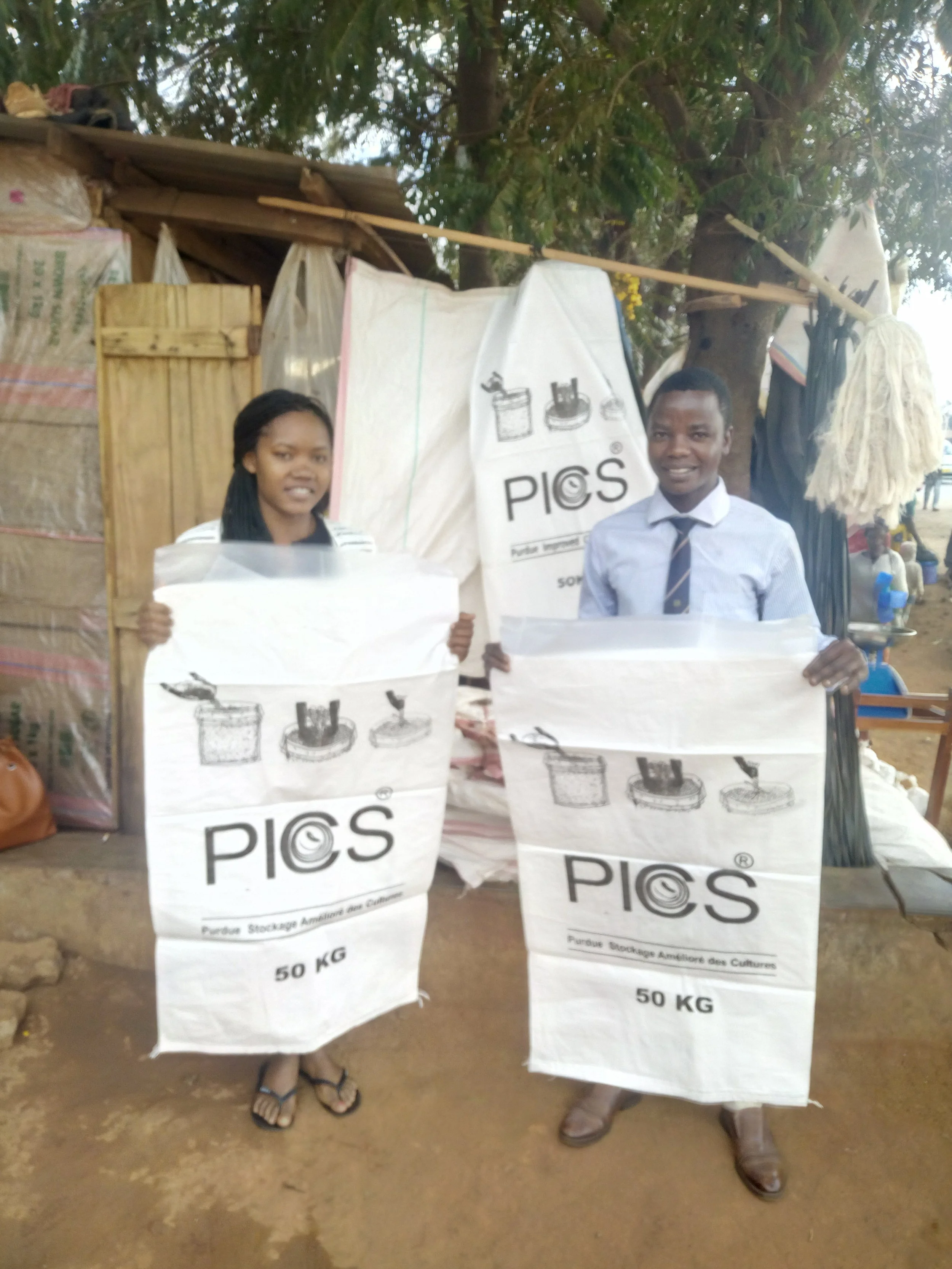
PROVEN INTERVENTION TO BE DISTRIBUTED
Purdue Improved Crop Storage (PICS) bags are a triple-layered plastic bag that serves as an air-tight storage method for harvested crops.
Learn more about the Custom Challenge and why we only fund ideas that focus on distributing proven poverty interventions.
DISTRIBUTION MODEL INNOVATION
Agri Eco Enterprise (AEE) aims to boost the lives of 100,000 Malawian smallholder farmers over the next few seasons through the distribution of Purdue Improved Crops Storage (PICS) bags in the districts of Dowa, Lilongwe, and Kasungu. Many enterprises focus on selling local bags, which are less effective.
AEE will recruit agents who will be distributing the PICS bags to smallholder farmers on commission basis. PICS will be supplied by poly pack Malawi Company which will be distributed to various agents in the targeted districts. The agents will be the shop owners who are already selling farm produces, seeds, pesticides, fertilizers and many others.
PILOT AND SCALING GOALS
Distribute 50,000 PICS bags in first three months
Reach 10,000 farmers with training and PICS bags in first three months
Reach 1 million farmers by Y5
FOUNDING TEAM
Ms. Joyce Sikwese - Executive Director
Mr. Sanderson Banda - Marketing Officer
UP Scaling PICS Bags Technology
Their team will establish relationships with rural based farm input traders (agro dealers) and associations as outlets in Malawi so that farmers can easily access PICS bags instead of relying on central shops.
CUSTOM CHALLENGE; MALAWI
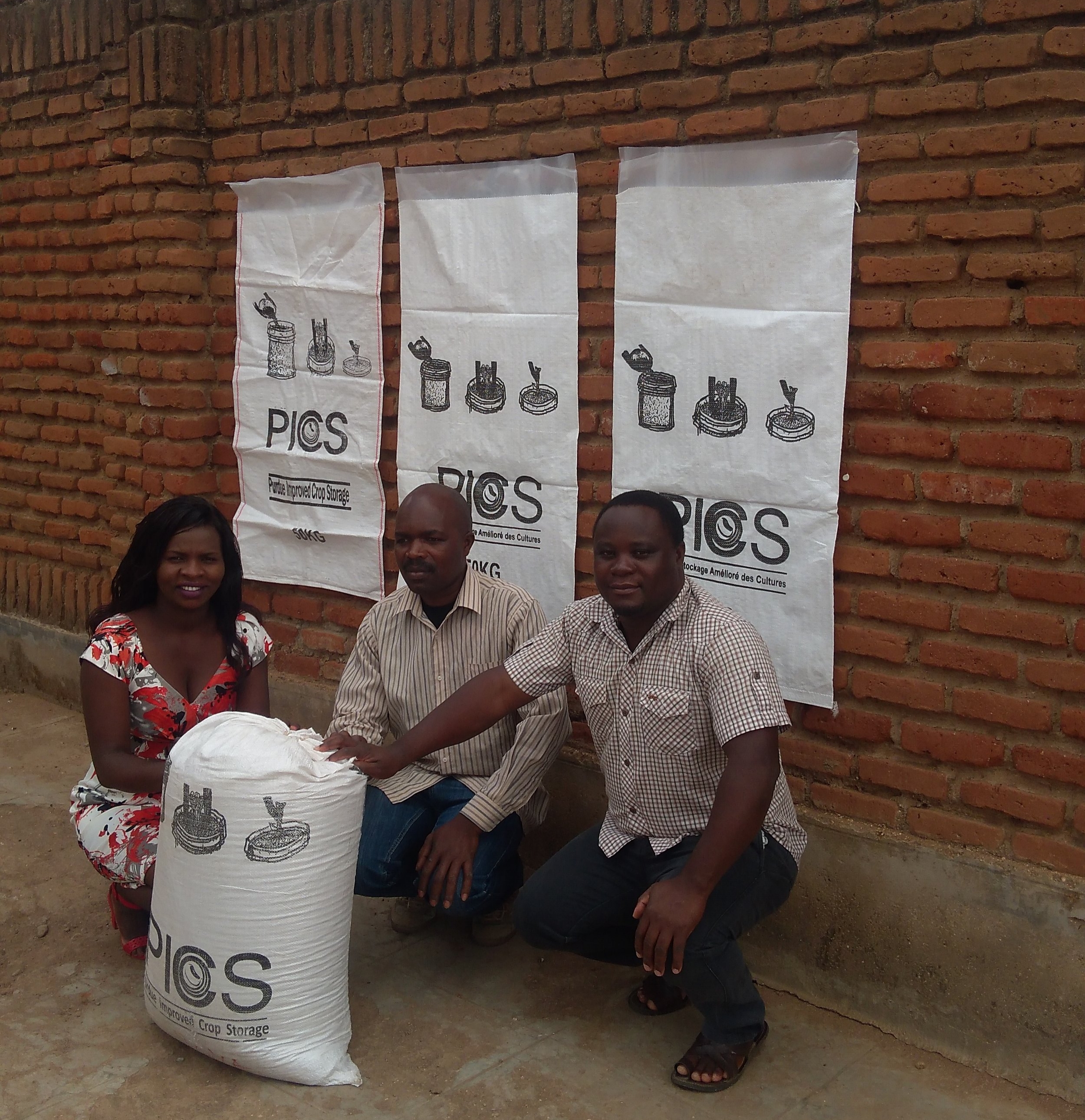
PROVEN INTERVENTION TO BE DISTRIBUTED
PICS post-harvest storage bags.
Learn more about the Custom Challenge and why we only fund ideas that focus on distributing proven poverty interventions.
DISTRIBUTION MODEL INNOVATION
Despite PICS bag Technology being very effective with up to 100% post-harvest loss reduction, the distribution chain in Malawi has been poor with limited players. There are 3 major barriers to accessing the technology: the distance from the production factory, limited players in the distribution chain, and generally a lack of knowledge amongst the farmers and agriculture extension workers on the availability of the technology and how it works.
The UP Scaling PICS Bags Technology team will establish relationships with rural based farm input traders (agro dealers) and associations as outlets so that farmers can easily access PICS bags instead of relying on central shops. That means the team will have selling points in rural trading centers. 5 selling points will be established. At each selling point, they will have a qualified extension worker responsible for on the spot demonstrations for farmers and agro dealers when they buy PICS bags. These will also be extension agents with designated impact areas where they will be working with farmers in demonstrating use and increasing awareness on the cost effectiveness of the bag. Agro dealers will be provided with training and awareness materials to increase valid sources of information. Each agro dealer through agriculture extension agents will have 10 anchor farmers to pilot and demonstrate effectiveness of PICS bags.
By the end of the pilot year, the team will sell 100,000 PICS bags and reach at least 20000 smallholder farmers, reducing post-harvest losses and contributing to poverty reduction through increased food and income.
As the organization scales, it will begin to distribute other impactful products including other high-quality seed and solar lamps.
PILOT AND SCALING GOALS
Sell 100,000 PICS bags by the end of year 1
Reach 20,000 smallholder farmers with information by the end of year 1
Reach over 100,000 grain growers and consumers by the end of year 5
FOUNDING TEAM
Kondwani Khonje - Manager
Prisca Gondwe - Accountant
PHK Trading
PICS bags are potentially the next revolutionary product for safe grain storage for millions of farmers in Ethiopia. The inner lines of the bags greatly hinder the movement of oxygen across the wall of the bag, killing insects. The tough outer woven bag enables to bag to be easily handled. PHK Trading will increase sales and distribution of PICS bags by adoping a youth reseller model.
CUSTOM CHALLENGE; ETHIOPIA

PROVEN INTERVENTION TO BE DISTRIBUTED
Purdue Improved Crop Storage (PICS) bags are a triple-layered plastic bag that serves as an air-tight storage method for harvested crops.
Learn more about the Custom Challenge and why we only fund ideas that focus on distributing proven poverty interventions.
DISTRIBUTION MODEL INNOVATION
Ethiopia produces over 300 million quintals (1 quintal = 100kg) of grain per annum. Post-harvest loss in Ethiopia is estimated at about 22-30%, equivalent to approximately USD $230 million. The most notable causes of this post-harvest loss are attacks from weevils, rodents, and moisture or growth of mold. Farmers use different traditional and modern technologies to control insects. The most popular traditional method is the use of underground pits which can lead to mold growth.
PICS bags are potentially the next revolutionary product for safe grain storage for millions of farmers in Ethiopia. The inner lining of the bags greatly hinders the movement of oxygen across the wall of the bag, killing insects. The overall efficacy of the bags in protecting grain or seed from infestation is reported to be over 99%.
PHK Trading will increase sales and distribution of PICS bags by adoping a youth reseller model. Local youth with close relationships to local shop owners will be a key component of the supply chain. As sales agents, these youth resellers will take PICS bags from local vendors on credit, travel to markets in a particular community in order to bring the bags closer to smallholder farmers, sell the bags, and take home a $.19 margin per bag sold.
The youth resellers will be chosen carefully on recommendations from local elders and will be tested to assess their entrepreneurial spirit. They will also receive training and professional development. PHK trading will hold demonstrations of the PICS bags in targeted villages with clusters of farmers to increase awareness of the product.
PICS technology has been introduced to more than 50,000 villages across Sub-Saharan Africa. The bags are manufactured and sold in 28 countries in Africa and Asia. To date, more than 12 million PICS bags have been sold with the scale up funded by Bill and Melinda Gates Foundation and executed by Purdue University. PHK Trading is authorized by Purdue University to commercialize PICS bags. Over a period of two years, farmers will see a 123% return on investment.
PILOT AND SCALING GOALS
Recruit 60 youth resellers by the end of year 1
Distribute 45,000 bags by the end of year 1
FOUNDING TEAM
Yared Sertse - Project Leader
Yemisrach Getachew - Project Coordinator
Michael Tariku - Project Coordinator
Are you ready to be the next great social entrepreneur?